Why are Brize Norton protesters charged under the National Security Act? Section 4 explained
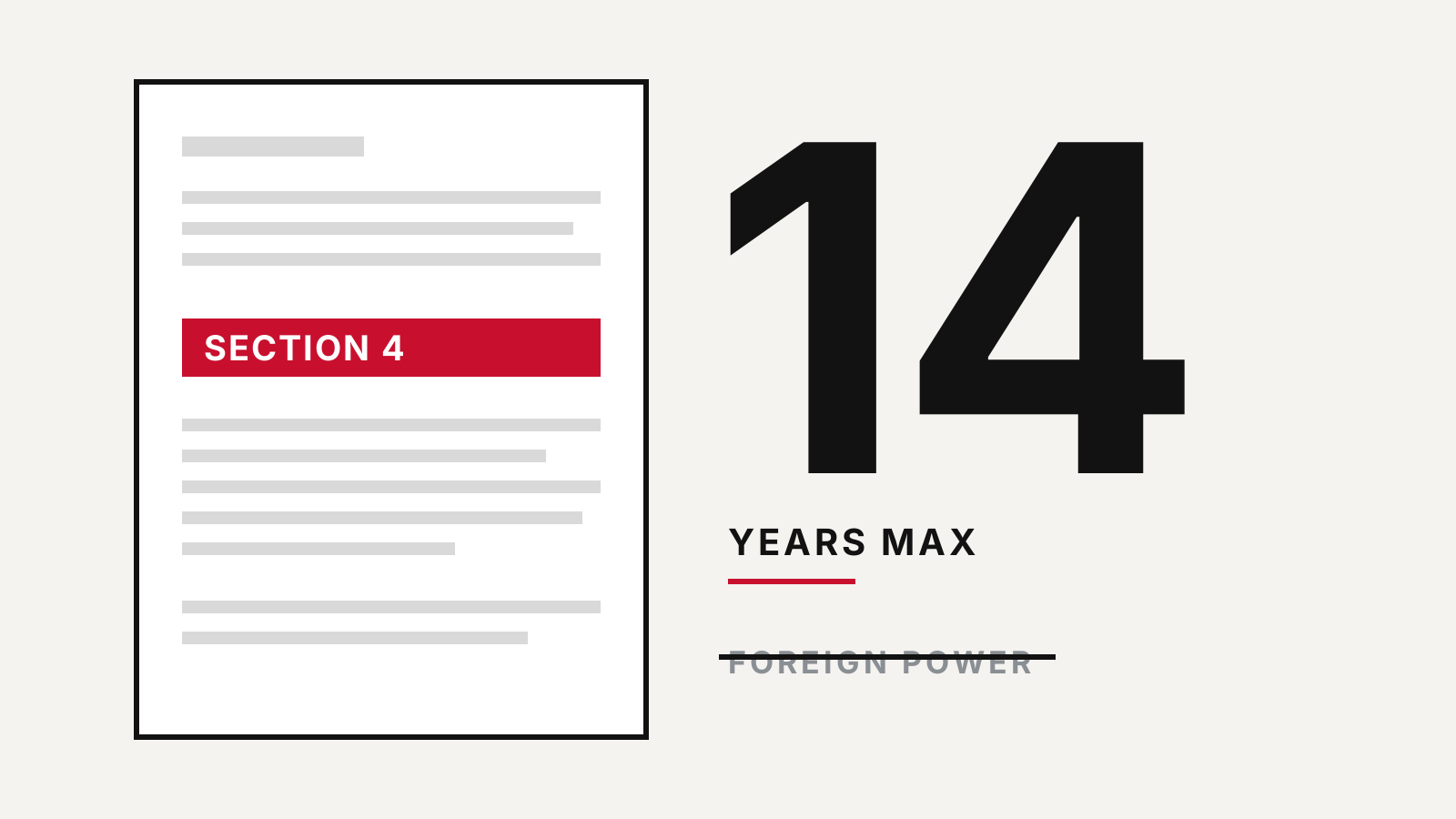
Section 4 of the National Security Act 2023 covers entering a prohibited place for a purpose prejudicial to UK interests. It needs no foreign power, and the maximum sentence is 14 years.
Key points
- Section 4 of the National Security Act 2023 requires entering or approaching a prohibited place for a purpose the defendant knows, or ought reasonably to know, is prejudicial to the safety or interests of the UK.
- Unlike most offences in the Act, section 4 has no foreign power condition, so no foreign state or interference needs to be proven. The maximum sentence is 14 years.
- The charges against the six people accused over the Brize Norton action are the first use of the Act against a domestic protest group.
- Proceedings under section 37 need the consent of the Attorney General, which is a separate safeguard from the CPS charging decision.
The six people accused over the action at RAF Brize Norton on 20 June 2025 face conspiracy charges under section 4 of the National Security Act 2023. They deny the charges.
#What does section 4 require?
Section 4 has two parts, and the prosecution has to show both.
- The conduct: accessing, entering, inspecting or approaching a prohibited place. A prohibited place is a protected site, such as a military base.
- The purpose: doing so for a purpose the defendant knows, or ought reasonably to know, is prejudicial to the safety or interests of the United Kingdom.
Section 4 is not one of the offences that depend on the "foreign power condition" in section 31 of the Act. That condition applies to other offences, including section 1 (protected information), section 12 (sabotage) and section 13 (foreign interference). The wording of section 4 matches the offence that replaced section 1 of the Official Secrets Act 1911.
The dispute is over the phrase "interests of the United Kingdom". The defence argues that domestic protest aimed at UK foreign policy was never meant to fall within an espionage statute. The Crown's position is that the words mean what they say.
#Why is this the first use against a protest group?
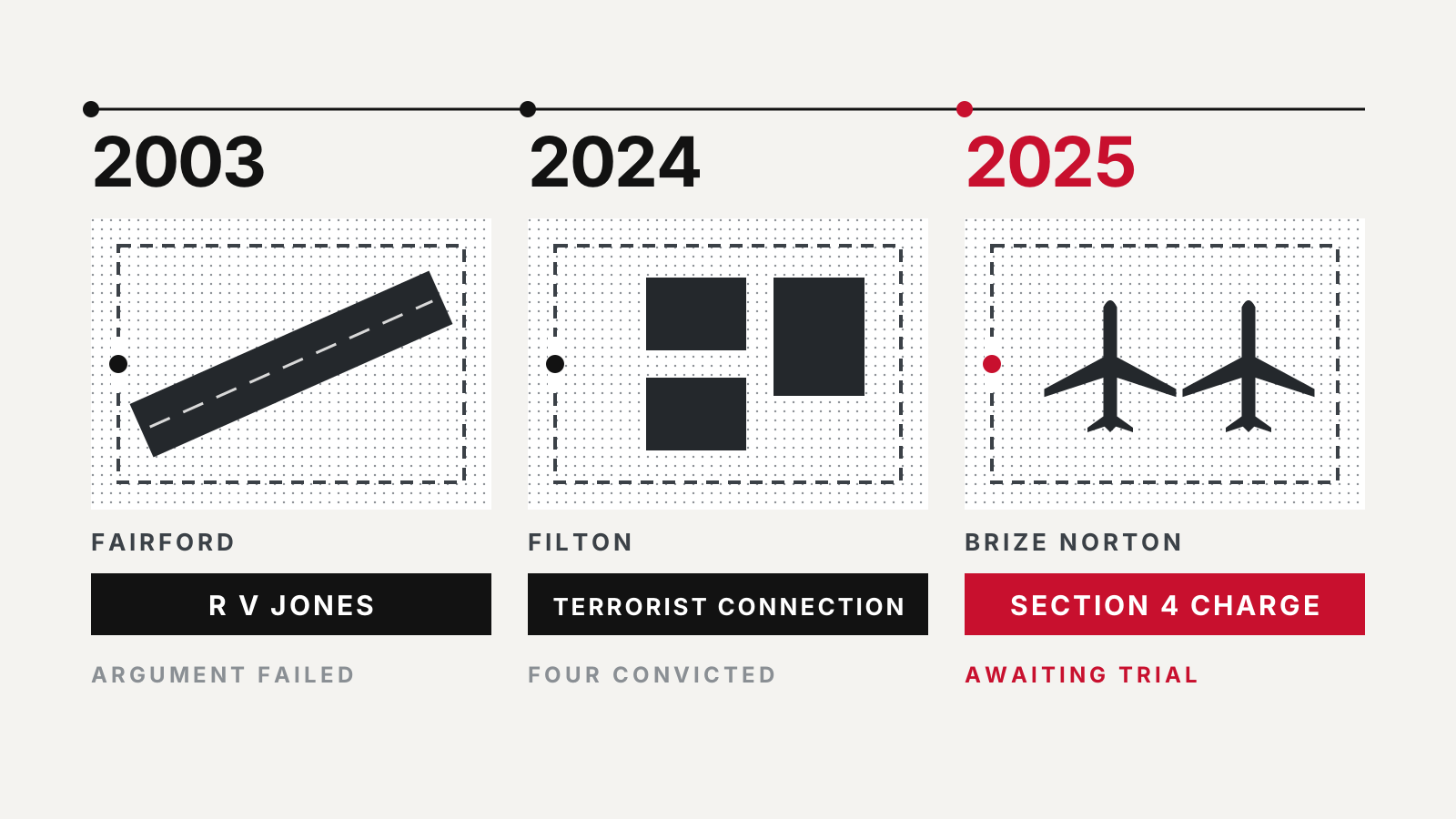
The Brize Norton case is the first time the Act has been used against a domestic protest group.
The first people charged under the Act were three Iranian nationals, accused in May 2025 of "engaging in conduct likely to assist a foreign intelligence service". In October 2026, two men were charged "under Section 4 of the National Security Act 2023", the same section as the Brize Norton accused, over an incident at RAF Fairford. All three cases are ongoing.
Charge details come from press reporting of the court hearings, not from the indictment, so the exact counts could be refined before trial. The timeline of the case sets out the hearings so far. The trial is due to begin on 25 January 2027 at Woolwich Crown Court.
#What is the Attorney General's role?
Section 37 of the Act requires the Attorney General's personal consent before proceedings can start for any Part 1 offence. Some minor offences are excluded, including section 5 (unauthorised entry), section 6, section 11 and the offences in Schedules 2 to 4. Section 4 is not excluded, and the same consent requirement applies to the conspiracy count under section 4(3) of the Criminal Law Act 1977.
The process has two stages. The Crown Prosecution Service makes the charging decision under the Full Code Test, and the Counter Terrorism Division handles National Security Act cases. The CPS then applies to the Attorney General for consent before proceedings are instituted. The consent is a separate public-interest safeguard, not a formality. It is exercised personally by the Attorney General or the Solicitor General, not delegated to prosecutors.
The Attorney General at the time of the protest was Richard Hermer, who took office on 5 July 2024. The reporting used here does not say which law officer gave consent in this case.
#What is the 'terrorist connection' allegation?
The prosecution says the offences have a "terrorist connection". If any of the accused are convicted, that finding would affect sentencing. In the Filton case, a similar finding added years to the sentences (Express & Star / PA). No verdict has been reached at Brize Norton, so the allegation has not been tested.
Palestine Action was banned after the protest. As a result, according to the charges reported so far, the accused cannot be charged with membership of a banned group for the protest itself. For the ban, see the background to the ban.
#What did Jonathan Hall KC say about counter-subversion?
Jonathan Hall KC is the independent reviewer of terrorism legislation and state threat legislation. In his 2025 John Creaney QC Memorial Lecture, "Terrorism and National Security: Internal Threats and Internal Fears", he said he no longer considers "State Terrorism" to be "a useful concept". He argued that the line between acts of terrorism and national security threats is increasingly blurred.
He called for the government, intelligence services and judiciary to be ready to use "counter-subversion" tactics to defend "the realm from internal dangers arising from actions of person and organisations which may be judged to be subversive of the State". He acknowledged that such tactics are "associated with McCarthyism and some unjustified infiltrations of domestic protest groups by undercover police".
Hall framed his list of contexts as what a hostile foreign intelligence officer might do, "thinking like an adversary". His remarks are general commentary on the Act and its use, not a comment on the Brize Norton accused. The full piece on his lecture sets out his remarks in more detail.
Questions and answers
What is section 4 of the National Security Act 2023?
It covers entering, accessing, inspecting or approaching a prohibited place, such as a military base, for a purpose prejudicial to UK safety or interests. The prosecution does not have to show that a foreign state was involved.
What is the maximum sentence under section 4 of the National Security Act?
The maximum sentence for a section 4 offence is 14 years in prison.
Why was section 4 used against the Brize Norton protesters?
The six are accused of conspiring to commit a section 4 offence over the action at RAF Brize Norton on 20 June 2025. The defence argues domestic protest over UK foreign policy was never meant to fall within an espionage statute, while the Crown says the words mean what they say.
Sources
- Five pro-Palestinian activists plead not guilty over UK air base break-in
- Four face 2027 trial over alleged Palestine Action aircraft damage
- Terrorism and National Security: Internal Threats and Internal Fears
- National Security Act 2023
- Charges under Section 4 of the National Security Act 2023 at RAF Fairford